Past Product: VR Research
Web
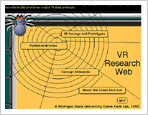
PI: Carrie Heeter
Graphics: Pericles Gomes
The VR Research Web is a CD-ROM collecting a series
of virtual reality research studies conducted by Carrie Heeter.
It was created in 1992, prior to the maturation of the World Wide
Web as a communication medium. Thus, it has nothing to do with the
Internet, despite the name.
Eventually I will post the studies, surveys, and
video clips included on the VR Research Web CD-ROM on this page.
Here's a beginning, Once Upon A 3D Time.
Once Upon a 3-D Time...
(3-D Second Person Virtual Reality)

About the Cyberarts Installation:
This Interactive Installation combines ENTER™
3-D stereoscopic video laserdisc and codec technology with Mandala
second person Virtual Reality on an Amiga computer and a Macintosh
for additional sound and video processing. The live, chromakeyed
participant (you) becomes part of a 3-D stereoscopic motion video
environment (the virtual world). You experience a curious, compelling
transformation which places you inside 3-D photorealistic interactive
space on a life-sized screen. This integration of interaction with
graphical objects and interaction with stereoscopic 3-D motion video
creates out of body experiences which are strikingly real. Initial
research by Michigan State University shows that participants feel
as if they are entering a different world. People report an overwhelming
desire to interact.
In this installation, we experiment with second
person VR interfaces. Instructions are given in the form of a story
naration, as if describing something that happened in the past (e.g.:
when the sorcerer touched the ball, the scene would change...).
We use a silhouette body as cue to where to stand. Instead of “clicking
on” objects, you stand on them. Initially, the silhouette
is generic, until you select an identity (sorcerer or inventor).
We try several modalities to try to let you actually interact with
video. The crystal ball and the 3-D motion viewmaster are interfaces
where it is natural to be able to touch them and change scenes.
In both cases, you manipulate a portal to the video world, interacting
by controlling the video rather than being immersed in it. As the
story progresses, you enter one of the video worlds. With different
motivations (selecting ingredients for a magic potion and testing
molecules for a medical cure), the sorcerer and inventor make choices
about objects in the video world will be brought into the graphic
world and become part of the story.
Even though the story stops at “THE END,”
this is only the beginning of our work with second person VR interfaces.
About the Artists:
Carrie Heeter (Director, Michigan State University
Comm Tech Lab), Michael Miller (Chairman, ENTER Corporation), and
Pericles Gomes (Senior Designer, Michigan State University Comm
Tech Lab) developed this interactive installation. Heeter programmed
the interation, Miller produced the 3-D video and Gomes designed
the Amiga graphics. All three artists contributed to conceptualization.
The installation is part of an ongoing program of research and development
into new ways of using second person VR for education and entertainment.
Artists: Carrie Heeter, Michael Miller and Pericles
Gomes
Hardware: Amiga Computer, Pioneer LaserDisc, cameras
and chromakey switcher, lights, ENTER™ custom 3-D technology,
Macintosh IIci.
Software: Mandala, HyperCard, SoundEdit, DeluxePaint III
AWARDS:
-- exhibited at SIGGRAPH, 1993
|